Want to watch it instead? Check out my video!
If you feel like you’re constantly reminding your kids what to do in your homeschool… you’re not alone.
“Get your pencil.”
“Finish your work.”
“Clean up.”
“Come back to the table.”
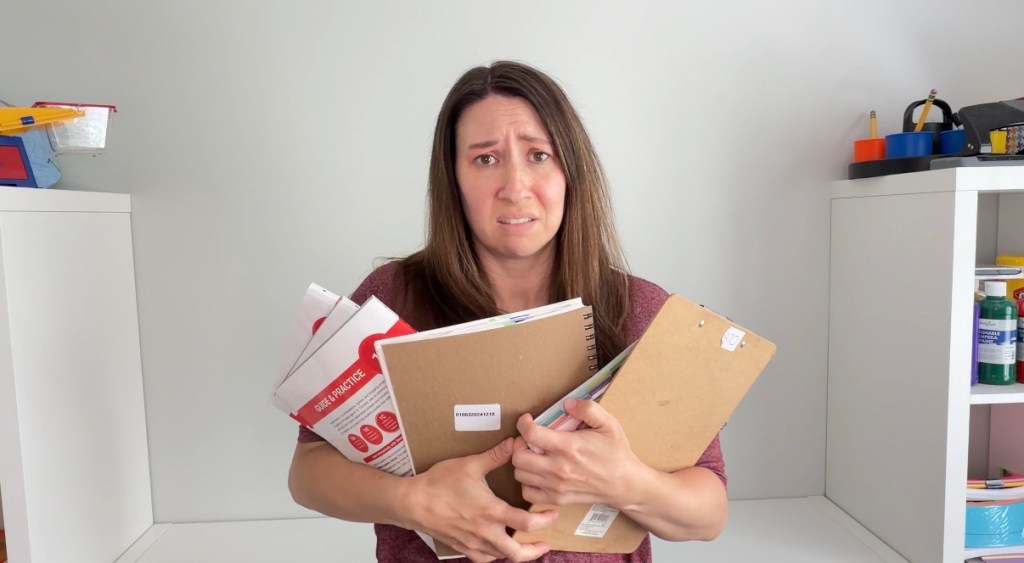
By the middle of the day, it can feel like you’re carrying the entire homeschool on your shoulders, and no matter how many times you repeat yourself, nothing actually sticks.
And here’s the part that most homeschool moms quietly wonder:
Why does everything still depend on me?
The truth is, this isn’t a discipline problem.
It’s not a motivation problem.
It’s a missing structure problem.
Because responsibility isn’t something kids just have.
It’s something we have to teach, model, and build, intentionally, inside our homeschool day.
Why Your Kids Rely on You for Everything (Even in a Homeschool Setting)
In traditional school, responsibility is often built into the system:
- routines are structured
- expectations are consistent
- independence is gradually expected
But in homeschool?
Everything flows through you.
You choose the curriculum. You set the pace. You guide the day.
So naturally, your child learns:
“Mom will tell me what to do next.”
And without realizing it, we create a homeschool where:
- kids wait instead of act
- kids rely instead of initiate
- kids depend instead of take ownership
Not because they can’t be responsible…but because they haven’t been taught how to be..yet.
This is especially true in the early elementary years, when children are just beginning to learn how to take ownership of their time, materials, and responsibilities.
What Actually Builds Responsibility in a Homeschool
Here’s where most approaches fall short:
They focus on:
- charts
- checklists
- rewards
- reminders
But responsibility isn’t built through managing behavior. It’s built through layers of intentional practice over time.
After 13 years in the classroom, and now homeschooling my own kids, I’ve seen this over and over again:
Kids become responsible when we stop expecting it… and start teaching it.
And that happens through five simple layers:
1. Modeling (What They See)
Children learn responsibility by watching it in action.
Not just being told:
“Clean up your things”
But seeing:
- how we take care of materials
- how we follow through
- how we handle responsibility ourselves
But here’s the part that often gets missed:
Modeling only works when children are aware of it.
Because you can model responsibility all day long…cleaning up, finishing tasks, taking care of your home, and your child may not connect any of it to themselves.
They’re not thinking: “Oh, this is what responsibility looks like.”
They’re just watching life happen.
Which is why modeling needs to be paired with intentional awareness.
This can be as simple as saying:
- “I’m putting this away because I take care of my things.”
- “I said I would do this, so I’m following through.”
- “I’m finishing this before I move on.”
Now your child isn’t just seeing responsibility… they’re beginning to recognize it.
And once they can recognize it, they’re far more likely to begin practicing it themselves.
2. Belief (What They Think About Themselves)
This is the piece most people miss.
A child who believes:
“Mom will do it”
…won’t try.
A child who believes:
“I can do this”
begins to take ownership.
But belief isn’t built by saying: “You can do it.”
It’s built through what your child experiences every day.
In a homeschool setting, it’s easy for kids to learn:
- “Mom will remind me”
- “Mom will help me”
- “Mom will step in if this is hard”
So their belief becomes: “I don’t have to do this on my own.”
To shift that, we have to shift the experience:
- pause instead of jumping in
- give them time to think
- expect small follow-through
- allow a little struggle
And then name it:
- “You did that on your own…that’s responsibility.”
- “You remembered what to do next, that shows you can do this.”
Now they’re not just hearing encouragement, they’re starting to believe it.
3. Daily Practice (What They Do Repeatedly)
Responsibility is not a one-time lesson.
It’s built into the small, repeated moments of your homeschool day.
Not just talking about responsibility, but practicing it consistently:
- putting materials away before moving on
- getting started without being told
- following through on a task
- helping in simple, expected ways
These moments may feel small…but this is where real change happens.
Because when responsibility is practiced daily,not occasionally, it stops being something you remind…and starts becoming something they do automatically.
4. Reflection (What They Notice)
Children need space to think:
- Did I follow through?
- What could I do better next time?
- How did my choices affect others?
This is how responsibility moves from: external reminders → internal awareness
5. Consistency & Layering (What Builds Over Time)
This is the part that requires patience.
Responsibility is not taught in a day… or even a week.
It’s built:
- slowly
- intentionally
- consistently
Just like academics.
What This Looks Like in a Real Homeschool Day
Instead of:
constant reminders
managing every step
repeating yourself all day
Your homeschool begins to shift into something different.
You start to see:
- your child beginning tasks without prompting
- small routines becoming automatic
- follow-through improving over time
Not because you said it louder…but because it’s been practiced consistently.
Why Most Homeschool Curriculum Misses This
Here’s something that might feel a little uncomfortable, but it’s important:
Most homeschool curriculum focuses almost entirely on academics.
- math
- reading
- writing
But very little is built around:
how your child shows up in their learning
Which is why you can have:
- a great curriculum
- a solid plan
…and still feel like: everything depends on you
Because without responsibility, even the best curriculum feels exhausting.
The Missing Piece: Teaching Responsibility Inside Your Homeschool
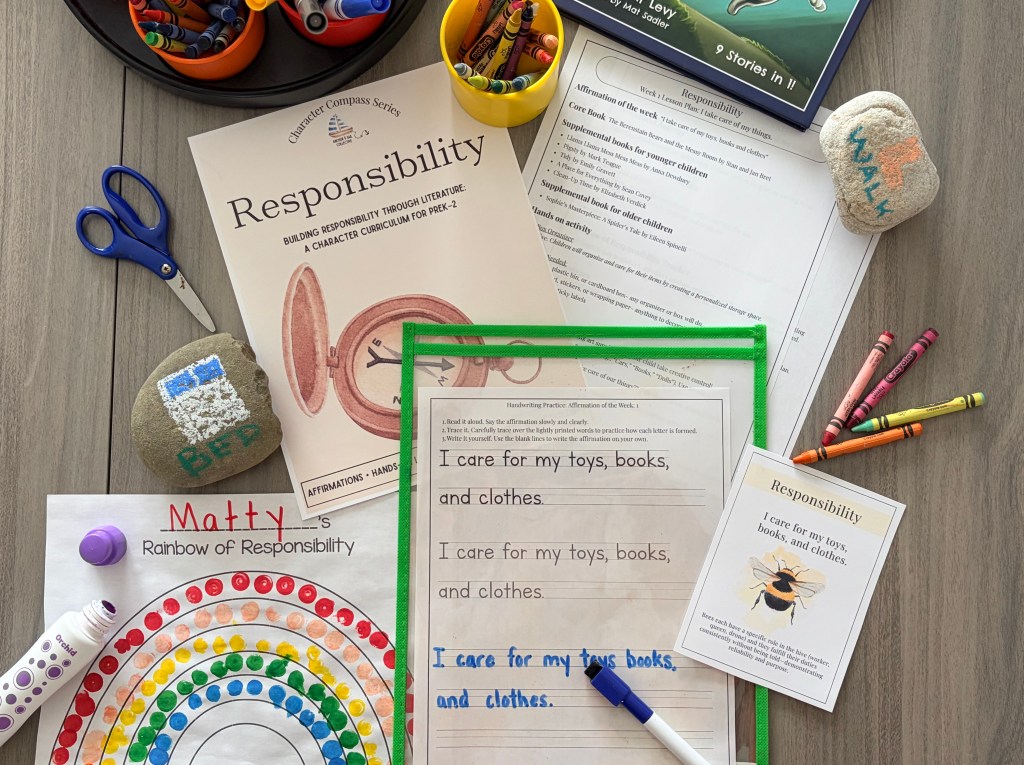
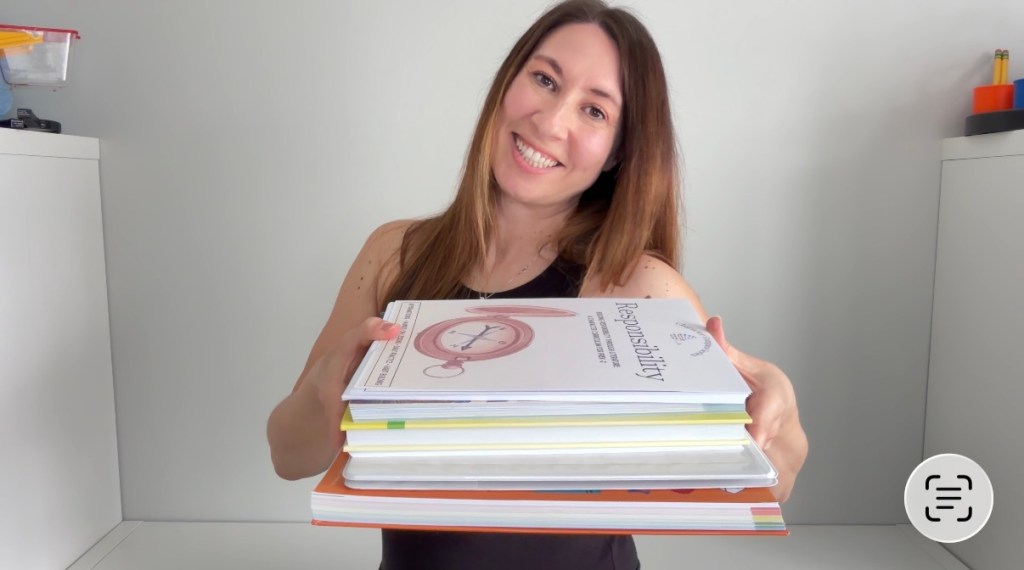
This is exactly why I created my Responsibility Unit for early elementary homeschoolers, designed for ages 4–8, when these habits are just beginning to form and are easiest to build.
You can find it here: Character Compass, Responsibility
Not as an add-on.
Not as another checklist.
But as a literature-based character curriculum designed specifically for homeschool families who want to build responsibility in a way that actually sticks.
Inside the unit, responsibility is not just talked about, it’s practiced through:
- meaningful picture books that model real-life situations
- simple affirmations that build belief and language
- daily conversations that connect learning to real life
- hands-on activities that make responsibility tangible
- reflection and habit-building woven into your actual homeschool rhythm
Character isn’t something we teach once and move on from, it’s something that grows through stories, conversations, reflection, and daily practice over time
Why This Matters More Than You Think
Because here’s the reality:
If responsibility isn’t built early…you will continue carrying your homeschool later
- reminding
- managing
- correcting
- overseeing everything
But when responsibility is built early?
Everything changes.
- your child takes more ownership
- your day feels calmer
- your role shifts from manager → guide
If You’re Feeling This… You’re Not Alone
If you’ve been thinking:
- “Why do I have to remind them of everything?”
- “Why can’t they just do it on their own?”
- “Why does homeschool feel so heavy?”
This is your sign.
Not that you’re doing something wrong.
But that something is missing from your structure.
A Simple Next Step
You don’t need to overhaul your homeschool overnight.
You don’t need a complicated system.
You just need:
a clear, intentional way to build responsibility into your day
If you want that already laid out for you, with the books, lessons, conversations, and daily practice built in…you can find my Responsibility Unit here.
It’s designed to help you stop wondering if you’re doing enough…and start building a homeschool where your child actually begins to take ownership.
Final Thought
Responsibility isn’t something we demand from our kids.
It’s something we teach, model, and practice, together, over time.
And when you begin to build it intentionally?
It doesn’t just change your child.
It changes your entire homeschool.




Leave a Reply