(And What Actually Helps Instead)
If you’ve ever wondered:
- Why does my child only listen when I yell?
- Why does nothing happen until I raise my voice?
- Why does yelling feel like the only thing that works?
You’re not imagining it. Most parents don’t want to yell. They start calm. They explain. They ask. And still—nothing happens. Until the voice goes up.
Suddenly your child moves. The task starts. The moment shifts.
Which leads to the question most parents quietly carry:
Why does this only work when I yell?
Here’s the part that matters: This isn’t a respect problem. It’s not a listening problem.
It’s a systems problem.
Why yelling seems to work (but only in the moment)
Yelling works for one simple reason: It creates instant clarity.
When a parent raises their voice, it signals:
- this matters
- this is happening now
- action is required
That clarity cuts through hesitation and forces movement.
Your child isn’t responding because yelling is good parenting. They’re responding because yelling removes uncertainty.
What kids are missing before yelling happens
Before yelling, many kids aren’t refusing. They’re stuck.
Without clear structure, kids often don’t know:
- where to begin
- how urgent something is
- what step actually comes first
So they pause.
Yelling doesn’t teach them how to start, it simply ends the pause.
How yelling quietly becomes the system
Over time, yelling becomes the clearest signal in the household. Not intentionally, but consistently. Kids begin to learn: I don’t need to act until things feel intense.
Which means:
- calm instructions feel optional
- urgency replaces structure
- parents become the trigger for action
Yelling turns into the “start button.” Not because kids need it,
but because nothing else in the system clearly signals when to move.
Why yelling doesn’t build independence
Yelling can trigger action in the moment.
But it doesn’t teach kids:
- how to recognize responsibility on their own
- how to initiate without emotional pressure
- how to act before intensity appears
So when the yelling stops, the behavior often stops too. Not out of defiance, but because the system never taught initiation.
Why “just staying calmer” doesn’t solve the problem
At this point, many parents think the solution is self-control:
I just need to stay calmer.
I need to yell less.
But calmness alone doesn’t replace yelling. Because yelling isn’t the real tool, clarity is. And clarity has to come from somewhere.
What actually replaces yelling
Yelling fades when structure takes its place.
When kids have:
- clear starting points
- predictable rhythms
- environments that quietly signal “now”
They don’t need intensity to act. The system carries the urgency, not your voice.
1. Create obvious starting points
Kids move faster when the first step is unmistakable. Clear starts reduce hesitation.
2. Build predictable rhythms
When routines are consistent, kids don’t need tone to interpret importance.
They know what comes next.
3. Let the environment cue action
Visual setup, placement, and design communicate expectations without volume.
4. Practice outside emotional moments
Skills form during calm repetition, not in the heat of frustration.
5. Define clear endpoints
Knowing what “finished” looks like prevents escalation.
The shift that changes everything
Yelling feels effective because it temporarily provides structure. But structure doesn’t need volume.
When kids know:
- when to act
- where to start
- how to move through a task
Where this comes together
If this feels like the missing piece, you’re not alone.
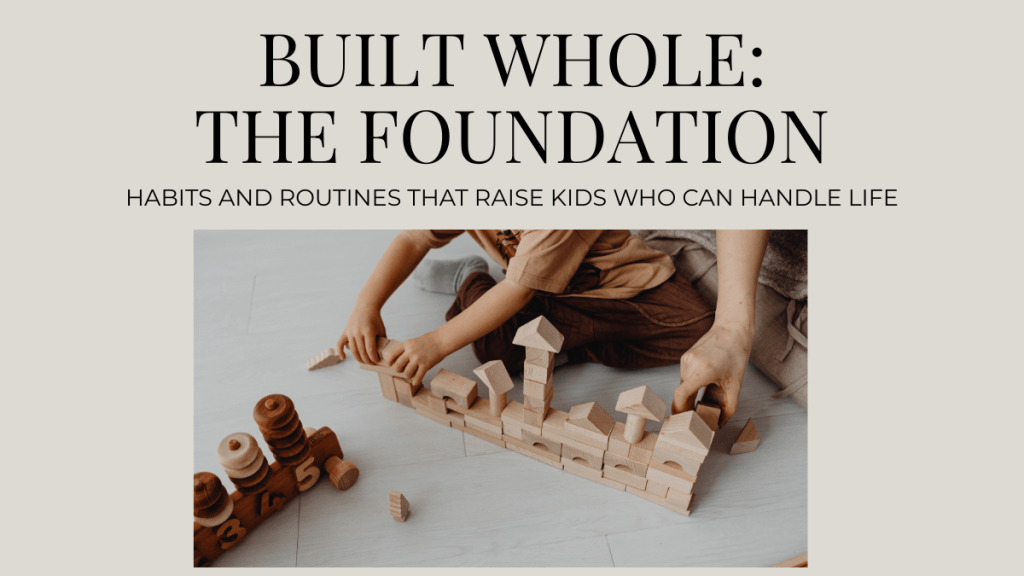
Inside Built Whole, parents learn how to replace urgency with structure so responsibility shifts from the adult to the routine itself.
Instead of relying on:
- raised voices
- emotional escalation
- last-resort intensity
Parents install systems that:
- teach kids how to initiate and follow through
- cue action automatically
- make expectations visible
A calmer way forward
Built Whole is a system-based approach to building responsibility, follow-through, and independence, without yelling or power struggles.
It’s practical, flexible, and designed for real family life.
If you’re ready to stop relying on your voice and start relying on structure, you can explore the full Foundation here:



 Anchor and Sail Collective
Leave a comment